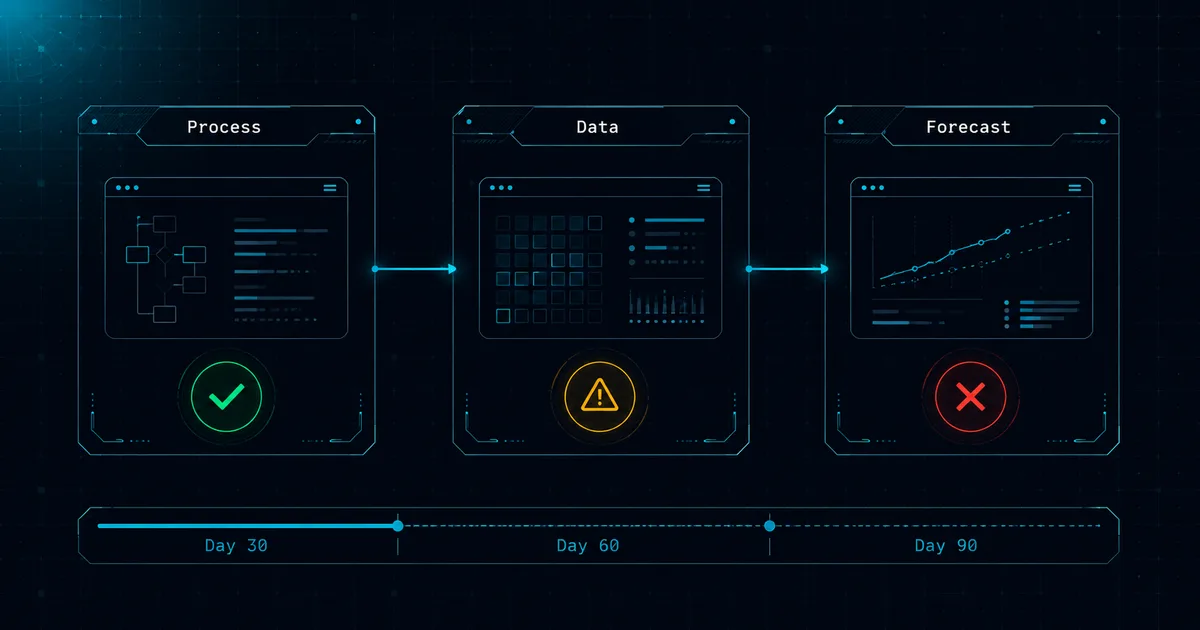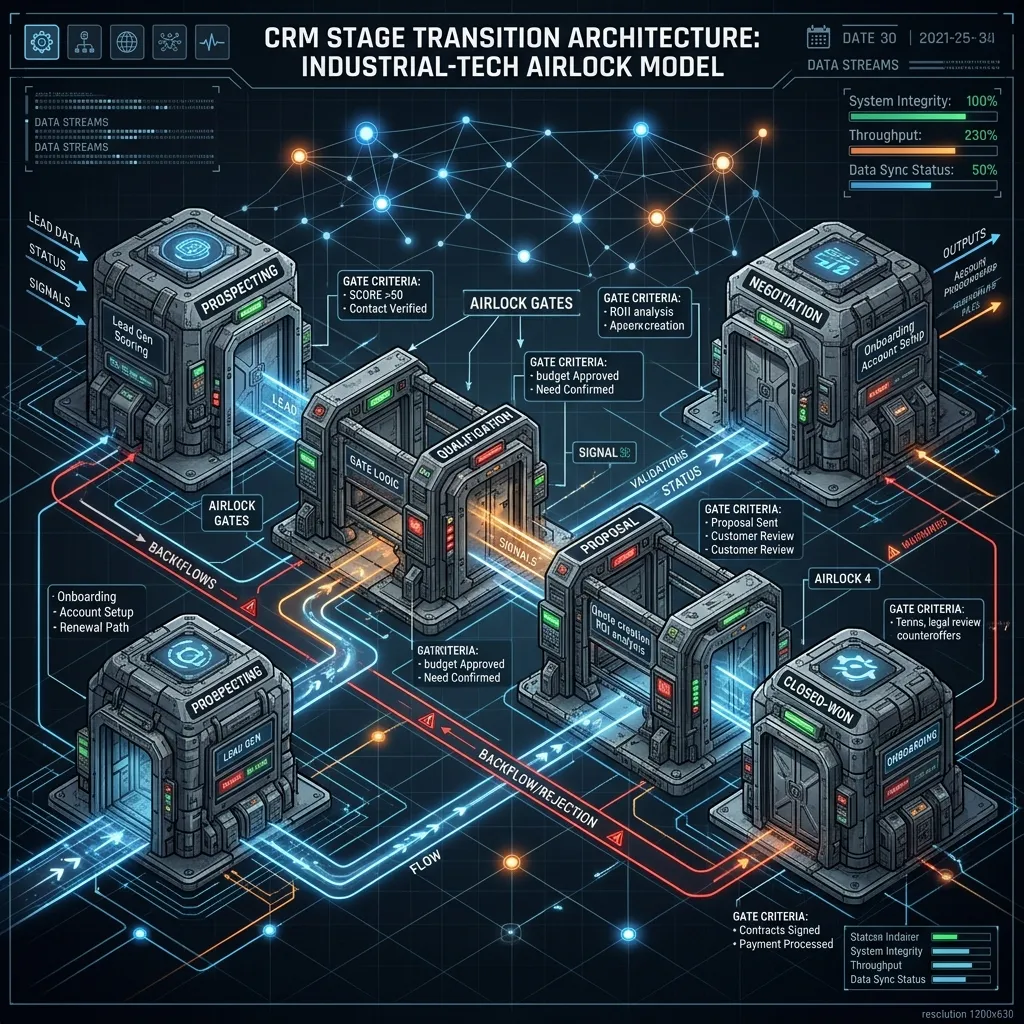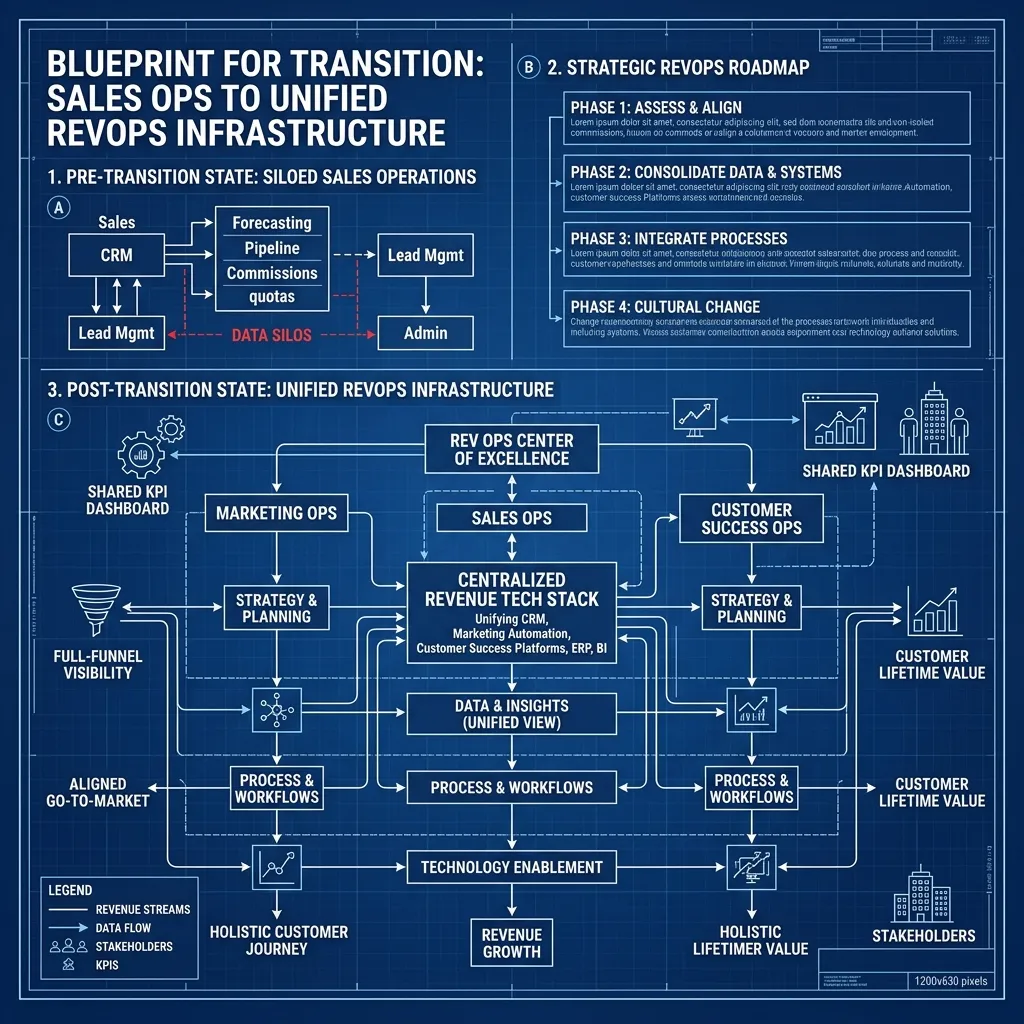

The short answer: RevOps (Revenue Operations) implementations fail not because the controls are wrong, but because they activate before the sales team has seen them operate. The sequencing rule is direct: install visibility before enforcement. Define stage-exit criteria, run them in shadow mode where non-compliant deals are visible to managers but deal movement is not blocked, then activate hard enforcement only for controls that survived the shadow period. For engagements that start mid-quarter, baseline and observe the current pipeline without changing rep workflow until an agreed reset point.
The first sign of a bad RevOps rollout is often not a broken CRM (Customer Relationship Management system). It is a sales leadership meeting that suddenly takes twice as long. Opportunities cannot move because required fields are missing. Managers start keeping side spreadsheets. Reps treat the new controls as administration rather than operating discipline. And because all of it happens while the team is carrying quota, the implementation gets blamed for every problem in the quarter.
The controls may not be wrong. The rollout sequence is.
Revenue controls, meaning stage-exit criteria, required CRM fields, pipeline inspection rules, and approval thresholds, are not optional in a well-run revenue organization. The sequencing question is what can change now, what should run in shadow mode, and what must wait until the team has absorbed the previous change.
This article is for the CFO or COO who has already decided to install revenue controls and wants a sequencing framework for doing it without losing a quarter in the process.
Why technically correct controls still break quarters
When hard CRM validation rules land on a sales team mid-quarter, the most common result is not adoption. It is what behavioral researchers call the "required field trap."
Sales reps facing a hard system gate that blocks deal advancement do not stop to improve their pipeline hygiene. They find the path of least resistance. Klu's 2025 analysis on sales productivity documents the pattern: when leaders respond to non-compliance by making ten to fifteen fields mandatory before a deal can advance, reps enter placeholder values, "TBD," or random text to clear the restriction. The CRM shows compliance. The data is worthless.
This is Goodhart's Law operating at scale: when a measure becomes a target, it ceases to be a good measure. A rep who needs to move a deal forward to protect a commission will type whatever clears the gate. The company gets clean-looking CRM records with zero diagnostic value. Practitioners call these "watermelon dashboards" -- green on the outside, red on the inside.
The data on CRM adoption reflects how often this happens. Gartner's 2026 analysis of 1,400 companies that implemented a CRM in the prior 36 months found that roughly 80% failed to meet the objectives used to justify the investment. Adoption failure, defined as the sales team not meaningfully using the system, was present in 71% of those failures. Fewer than 40% of CRM deployments reach greater than 90% active usage across the sales force (Weaver, CRM Graveyard Report, 2024).
There is also a structural timing problem that compounds the behavioral one. Any change to how deals progress through the pipeline mid-quarter corrupts the current forecast. A deal sitting in stage three under the old definition may not meet the exit criteria for stage three under the new one. That deal does not disappear from the CFO's numbers. It becomes a problem in the quarter-end reconciliation.
Controls imposed without a behavior-change sequence often produce the opposite of the intended result.
What disruption actually means
The word disruption gets used loosely in implementation reviews, and the loose definition creates real problems. Rep complaints during a process change are normal. The pattern to watch is something different and measurable:
- Administrative effort per opportunity increases materially
- Pipeline review meetings become longer rather than shorter
- Opportunities cannot move because of poorly designed field requirements
- Managers build spreadsheet workarounds to track what the CRM cannot reliably show
- Sellers update CRM data to satisfy the system rather than to reflect deal reality
- Forecast signal degrades during the rollout window independent of underlying business performance
Not all friction during a RevOps implementation signals disruption. Some friction is productive: a short adjustment period where the team learns a new operating discipline and settles into it within one or two review cycles. The distinction matters because the response is different. Short adjustment friction warrants patience and direct coaching. Disruption warrants stopping and redesigning the control before adding more enforcement.
Change management research from the Satir Change Model documents what happens in any structural process transition: there is an inevitable J-Curve performance dip before improvement. Sales cycles may temporarily lengthen. Early-quarter pipeline visibility may worsen as shadow pipeline gets purged. Close-date accuracy may deteriorate before it improves. This is expected, not a signal of failed implementation. The CFO's job during a RevOps rollout is to distinguish transient J-Curve friction from genuine disruption, in real time rather than in the post-mortem.
The rule: visibility before enforcement
Revenue controls should become visible before they become mandatory.
This single principle explains most of what separates RevOps implementations that improve pipeline quality from those that degrade it. When controls are visible but not yet enforced, three things happen that cannot happen under a hard-launch model: managers learn where their team falls short before there are consequences for it; reps see what will be required before it blocks their deals; and the operations team discovers which fields are genuinely impractical before they become locked requirements.
Prosci's change management framework, developed through analysis of change projects across more than 700 organizations, identifies five stages that individuals must pass through for organizational change to hold: Awareness, Desire, Knowledge, Ability, and Reinforcement. Projects with excellent change management execution meet or exceed their objectives 88% of the time. Projects with poor change management do so 13% of the time.
The most common RevOps implementation mistake is starting at Knowledge: operations builds the new stage logic, immediately mandates its use, and sends a training document. Reps who have not been given a reason to engage and have not chosen to participate do not learn from training. They wait for the mandate to go away, or they route around it.
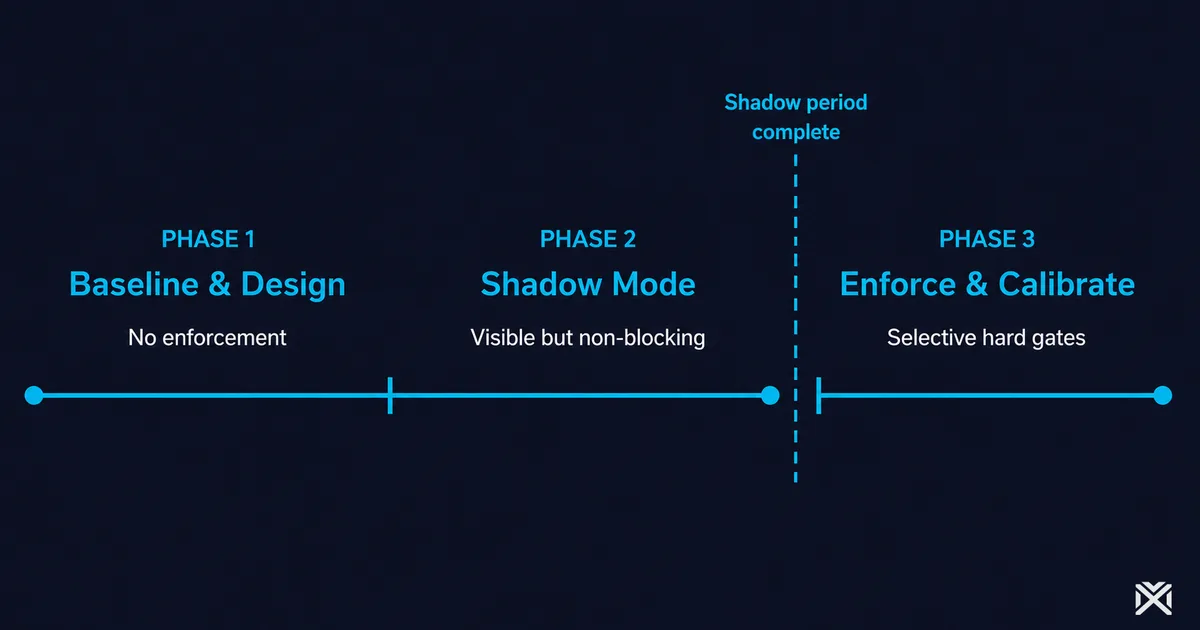
The three-phase framework below operationalizes visibility-before-enforcement across an implementation of any size.
Phase 1: Baseline and design without changing seller behaviour
Before any control touches the sales team, two things need to be true: the current state must be documented, and the future state must be defined and agreed on with sales leadership.
In this phase, you are configuring CRM infrastructure, not enforcing it. Stage definitions, exit criteria, required fields, and inspection rules are designed and built. The CRM accepts the new data model and surfaces the new fields, but no hard gates are turned on. Reps can advance deals without completing them.
The work in this phase:
- Baseline the current pipeline: stage distribution, average cycle time per stage, close-date slippage rate, field completion rates. This is the before measurement. A slippage rate above 30% at baseline indicates that stage progression is already disconnected from buyer reality, and that the controls are addressing a real problem rather than a hypothetical one.
- Map stage-exit criteria to verifiable buyer actions, not seller judgments. "Rep believes the deal is qualified" is not a criterion. "Economic buyer confirmed budget authority" is.
- Align sales leadership on definitions before reps see them. A VP of Sales who did not help design a criterion will not enforce it.
- Configure dashboards and exception reports so managers can see where deals would fail the new criteria before those criteria carry any enforcement.
If the engagement starts mid-quarter, this phase runs against the current quarter's pipeline as an observation exercise. Nothing changes for the sales team. You are watching and measuring.
Phase 2: Run the controls in shadow mode
Shadow mode means the system is tracking compliance, but movement through the pipeline is not blocked. Reps can see which fields are incomplete. Managers can see which deals would fail exit criteria. The exception dashboard shows flagged opportunities in real time. But no deal is stuck, and no rep is blocked.
GTM Skills, which has documented change management practices across hundreds of RevOps implementations (2024), recommends against "going cold turkey on critical revenue processes." Their framework calls for a parallel run of two to four weeks with a clear cutover date communicated in advance.
The mechanism that makes shadow mode work as more than a purely advisory phase is forecast exclusion. Non-compliant deals are excluded from the committed forecast roll-up, even though they can still advance through stages. A rep who leaves the required fields blank loses visibility in the CRO's committed pipeline. Their quota attainment looks weaker than it should, not because a gate blocked them, but because they chose not to complete the motion. This creates behavioral pressure without blocking deal movement.
When implemented using modern flow architecture (Salesforce Flow, for example), the technical approach is: allow the CRM save to commit to the database, then run asynchronous actions that set a compliance flag, update the manager's dashboard, notify the rep via Slack, and remove the deal from the committed forecast. No database rollback, no lost data, no technical frustration.
The shadow period does three things that the design phase cannot:
First, it surfaces workflow defects. Required fields that are impossible to complete because the underlying data does not exist in the CRM, or because the field appears at the wrong point in the workflow, show up immediately as widespread exceptions rather than isolated support tickets. If 80% of deals trigger a warning in week one, the design may be impractical.
Second, it separates structural non-compliance from behavioral non-compliance. If 80% of deals are missing a field in week one and 20% persist into week three, the 20% have been identified: these are the reps who need direct coaching before enforcement turns on.
Third, it creates a factual basis for enforcement. When a manager tells a rep in week five that the exit criterion goes live next week and the rep's last four deals all had the same missing field, the conversation carries data instead of policy.
Phase 3: Enforce only what survived the shadow period
When enforcement activates, it should activate selectively. Not every criterion designed in Phase 1 should become a hard gate in Phase 3. Shadow mode will have revealed which fields reps reliably complete when they understand the expectation, and which fields are producing persistent exceptions that indicate a design problem rather than a compliance problem.
Hard gates go on criteria that:
- Show high completion rates in shadow mode (the team has already adapted)
- Connect directly to pipeline quality outcomes the business cares about (close-date accuracy, qualification rigor, forecast confidence)
- Have manager override paths available for genuine edge cases
Criteria with persistent shadow-mode exceptions should be reviewed before enforcement: is the field in the wrong workflow position? Does it ask for information the rep cannot verify at that stage? Fix the design before turning on the gate.
The calibration work in this phase is ongoing. Exception rate per stage, manager override frequency, and escalation rate (what percentage of deals require above-threshold approval, target range: 10-15%) are the signals that tell you whether the controls are working. A well-calibrated implementation produces falling exception rates over successive review cycles. Flat or rising rates mean the controls have found a new workaround to compete with.
What if the engagement starts mid-quarter?
This is the situation where sequencing discipline matters most and is most often abandoned. In nearly every mid-quarter engagement we have been asked to assess, the pressure to show early progress has already led to controls being activated before the sales team knew what was being measured.
If a RevOps engagement starts in week four or five of a quarter, the correct position for most controls is: configure and observe, do not enforce until an agreed reset point. The one exception is a financial compliance or regulatory risk so serious that it cannot wait, covering controls tied to revenue recognition standards (ASC 606, IFRS 15), data privacy regulations, or export control requirements. That threshold is high and should require explicit CFO authorization.
For the current quarter:
- Baseline the existing pipeline using the new stage definitions as a lens, but do not change how reps work their deals
- Identify the highest-leakage handoffs and begin manager coaching around them without system enforcement
- Configure the new fields and dashboards so managers have visibility before quarter end
- Agree with sales leadership on the date when shadow mode begins, typically the first week of the following quarter
The practical reason for this sequence: any hard change to how deals move through the pipeline mid-quarter corrupts the current forecast. A deal in stage three under the old definition may not qualify for stage three under the new one. That deal does not disappear from the CFO's numbers. It becomes a reconciliation problem at quarter end that obscures whether the controls actually helped.
For the revenue operations consultant evaluation process, this sequencing question is worth raising before the engagement starts. A RevOps partner who proposes hard enforcement within the first quarter, without a documented shadow phase, is a risk signal.
Which controls to install first
Not all revenue controls carry the same disruption risk. Installing them in the wrong order compounds friction rather than reducing it.
| Install first (low disruption) | Shadow mode first (medium disruption) | Defer until stable (high disruption) |
|---|---|---|
| Pipeline and stage definitions | Stage-exit criteria checks | Hard CRM stage blocking |
| Manager inspection rules and review cadences | Required-field completeness | Large-scale opportunity reclassification |
| Forecast category definitions | Deal-age thresholds and alerts | Mandatory retrospective data cleanup |
| Dashboards and exception reports | Deal inspection scorecards | Compensation-linked enforcement |
| Data-quality diagnostics |
The sequencing principle here connects directly to what the stage-exit controls architecture article covers in structural terms: the architecture defines what the controls should be. This framework defines when each control should activate.
The underlying rule: install visibility before enforcement, and install manager behaviour before seller friction. Controls that managers have not adopted will not survive contact with the sales floor regardless of how the system gates are configured.
How to introduce controls without triggering resistance
Reps who resist controls are usually experiencing one of three things: they do not understand the requirement or why it exists; the workflow is impractical given how they actually work deals; or they are deliberately working around a control they understand but disagree with. Each requires a different response.
The first is a communication failure. The second is a design failure. The third is a manager accountability failure. Treating all three as the same problem by adding more required fields produces junk data without resolving any of them.
The ADKAR model maps the correct sequence: Awareness (why the margin leakage is real and costly), Desire (how faster Deal Desk approvals and cleaner pipeline reviews benefit the rep, not just the CFO), Knowledge (what the new fields and criteria actually require), Ability (practice during the shadow period without punitive consequences), then Reinforcement through calibrated enforcement.
Revenue controls introduced through the sales ops to RevOps transition journey hold better when sales leadership owns the "why" conversation with reps before operations owns the "how" conversation. The manager who uses shadow-mode data in every deal review creates the social enforcement that makes system enforcement feel consistent rather than arbitrary when Phase 3 activates.
Five warning signs the rollout is creating more disruption than control
1. Pipeline review meetings are longer after implementation than before it. If managers are spending more time reconciling data instead of coaching deals, the controls have added noise rather than signal.
2. Exception rates are flat or rising after three weeks of shadow mode. Exceptions should decline as reps adapt. Persistent exception rates indicate the criteria may be impractical or that managers are not using the data in their deal reviews.
3. A new spreadsheet appears in the weekly revenue review. This is the clearest signal that someone has lost confidence in the CRM and rebuilt their tracking outside the system. Rework's RevOps failure analysis identifies shadow spreadsheets as one of the most reliable leading indicators of implementation stall.
4. Close-date accuracy deteriorates while field completion improves. Reps are updating fields to satisfy the system without updating deal reality. This is the watermelon dashboard pattern in its early form: compliance is going up, but the CRM is less connected to the business than it was before enforcement.
5. Manager override volume does not change from week three to week eight. Overrides should decline as the team adopts the criteria. Flat override rates mean the gate is being worked around, not cleared.
How the CFO should measure whether the implementation is working
Business outcome metrics, including forecast accuracy, win rate, and sales cycle length, are the wrong primary signals for a RevOps rollout in progress. These metrics can move during any quarter for reasons unrelated to the controls: a down market, two large deals slipping, a new competitor entering a segment. Attributing their movement to the implementation, in either direction, produces false confidence or false concern.
This is the distinction Prosci's measurement framework builds on: organizational performance metrics (lagging, financial) must be separated from individual performance metrics (leading, process-level). A rollout can be mechanically healthy while business outcomes are temporarily suppressed by the J-Curve. A rollout can show clean business metrics while sitting on watermelon dashboards. The two readings are independent.
The reliable signals are implementation health metrics, measurable at the deal level before quarter-end results arrive. Anchoring these to system-stamped data rather than user-entered fields reduces the risk of measuring compliance theater rather than real adoption:
- Exception rate per stage per week: should decline over successive review cycles as teams adapt. Flat or rising means a design problem or a manager accountability gap.
- Manager override frequency: should decline as the team adopts exit criteria. Flat override rates mean the gate is being bypassed rather than cleared.
- Forecast change explainability: managers should be able to give a specific reason for any material forecast change within 48 hours. If they cannot, the pipeline data is not being used in the way the controls were designed to enable.
- Field completion without junk data: completion rate alone is not the measure. Spot-check a sample of completed fields for placeholder values, past close dates, and field responses that do not match the deal context.
- Shadow system presence: any new spreadsheet, Slack channel, or off-CRM tracking tool appearing after implementation is a leading indicator of lost confidence in the system.
The goal of sales forecast accuracy improvement is real, but it typically appears in the second quarter of a well-sequenced implementation, not during the transition itself. Setting that expectation with the board before the rollout begins is part of the CFO's job in sponsoring the change.
This is also the implementation sequence MxM Revenue Engineering uses when installing revenue controls: baseline and design first, shadow and coach next, then enforce and calibrate once the controls have survived real review cycles. The objective is not to make the CRM stricter faster. It is to improve pipeline discipline and forecast reliability without introducing unnecessary friction into a quota-carrying team. If you are evaluating a RevOps partner or reassessing an implementation already in progress, our revenue operations consultant evaluation guide covers the questions worth asking before the next layer of controls goes live.
If you recognize two or more of the warning signs above in a current or planned implementation, the Revenue Integrity Scorecard maps the specific control gaps before any enforcement goes live. It runs in two to three weeks and produces a ranked list of what to install first, which controls to shadow, and which to defer until the team has stabilized.