
A revenue operations consultant audits your pipeline architecture, CRM governance, and forecast mechanics, then rebuilds the controls that prevent revenue from leaking between commits and board reporting cycles. At $5M-$50M ARR, the role covers four mandates: process alignment across sales, marketing, and customer success; technology rationalization; data governance and definitions; and forecast integrity. The right engagement delivers measurable output within 30 days and board-ready reporting by day 90. The wrong one delivers slide decks, software sprawl, and a CRM your team is afraid to touch.
Only 17% of companies have fully centralized their revenue operations (LeanData / RevOps Co-op, 2025), and only 3% consider their function fully optimized (State of Nordic RevOps, 2025). The gap between those numbers and your revenue target is where this decision sits.
What does a revenue operations consultant do?
The job description varies by firm and by stage. In practice, a RevOps consultant operates across four interconnected mandates.
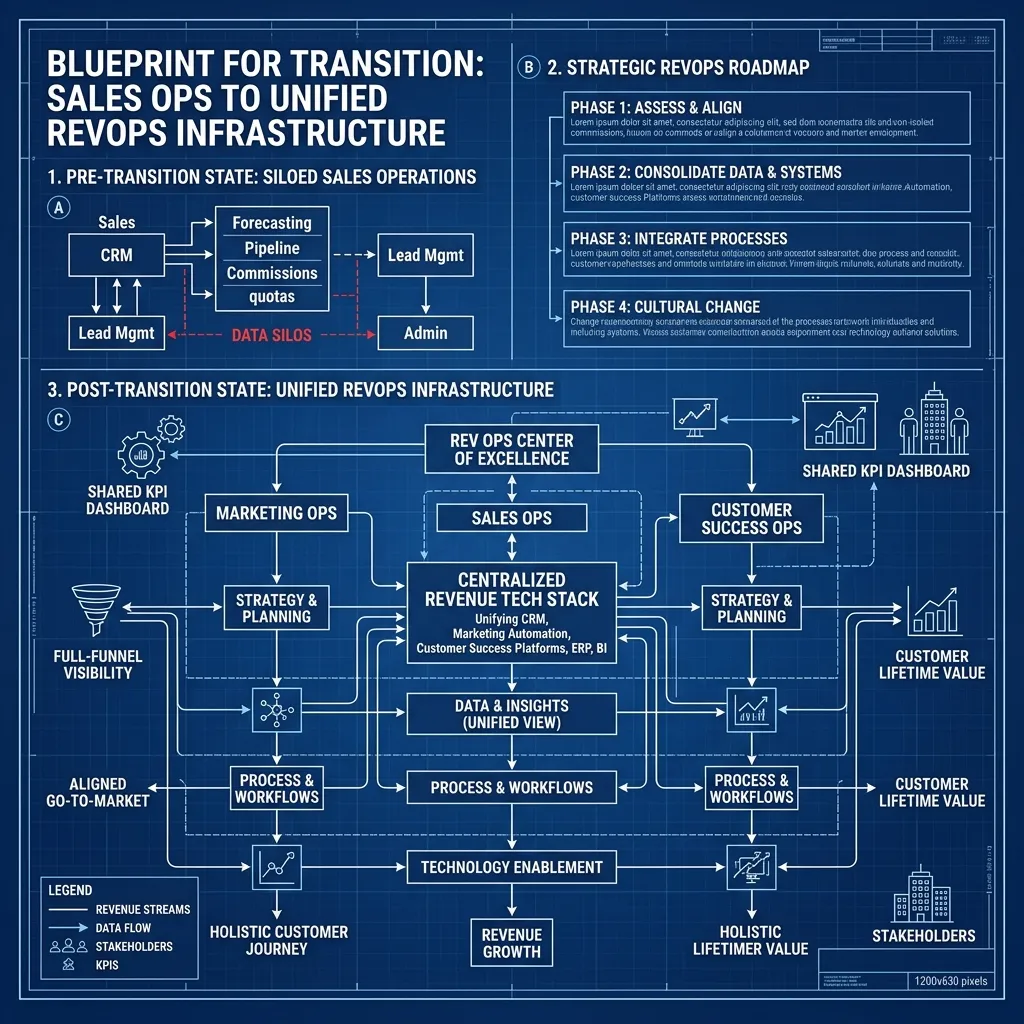
Process alignment means designing and enforcing handoff logic between marketing, sales, and customer success: MQL-to-SQL definitions, SLA timing, and the post-sale triggers that kick off onboarding. Without it, every team optimizes for its own metrics and blames the others when the number misses.
Technology rationalization means auditing what you have, removing what does not produce reliable data, and integrating the tools that remain so data moves without manual intervention. At $10M ARR, most companies carry 15-25 tools and use eight of them consistently.
Data governance is the mandate most engagements underscope. It means defining every field, assigning an owner, setting a refresh cadence, and enforcing the definitions through system logic rather than convention. A deal that sits in "Closing" because the rep has not updated the stage is a data problem, not a motivation problem.
Forecast integrity means rebuilding stage exit criteria so pipeline stage reflects verifiable buyer action rather than seller confidence. The forecast touches every stakeholder: rep, manager, CRO, CFO, board. Loose definitions corrupt the number at every level of the rollup.
These four mandates are not parallel tracks. A change to stage definitions changes the forecast model. A change to the attribution model changes what marketing calls a qualified lead. An engagement that treats them as separate workstreams will produce outputs that conflict.
When should you hire a revenue operations consultant?
The right moment is earlier than most companies act. Three specific signals are worth watching.
You have unexplained forecast variance. The quarter closes at a number nobody predicted, and the postmortem produces different explanations from every leader in the room. This is usually a definitions problem, not a talent problem.
GTM teams are blaming each other. Marketing says the leads are solid. Sales says they are not qualified. Customer success says the deal was mis-sold. If this conversation recurs every quarter, the handoff architecture is broken.
You are preparing for a funding round or PE diligence. Investors review pipeline data, forecast mechanics, and CRM hygiene directly. A fragile system that works for day-to-day selling will not hold up to external scrutiny.
One condition where bringing in a consultant does not yet make sense: if the founding team is still running sales directly. When the people setting strategy and the people closing deals are the same people, process changes rarely hold. The org design issue has to resolve first.
At the stage level: two or more quota-carrying reps with a dedicated marketing function is roughly the minimum for a RevOps engagement to produce durable results. Below that threshold, the data volume is too thin and the team too small for process architecture to create meaningful leverage.
Where most engagements fail
Most RevOps consulting underdelivers not because the consultants lack technical skills, but because the engagement model is built for observation rather than ownership.
The observation trap. A conventional engagement runs like this: stakeholder interviews, current-state mapping, framework application, final presentation. The output is directionally correct and operationally thin. A consultant might recommend that sales contact inbound prospects within five minutes of a form submit. What the recommendation misses is that the company's data enrichment process, where a contact passes through verification tools before routing logic can fire, introduces 10-15 minutes of latency by design. The recommendation is accurate as a principle and useless as an instruction. Consultants who have not run this under load at a company with similar architecture tend to produce advice that fails when the team tries to implement it.
Configuration without governance. The system is built and the consultant moves on. Three months later, nobody on the internal team knows why a specific automation is running or what breaks if it stops. The State of Nordic RevOps 2025 found that more than 75% of revenue teams rate their operational enablement as average or below. That number reflects what happens when an engagement hands off a system without transferring the logic that runs it. The team inherits a black box, learns to work around it rather than through it, and the CRM gradually diverges from how the business actually operates.
Forecasting theater. This is the pattern we see most often in pre-engagement reviews. A company hires a RevOps firm to improve forecast accuracy. The firm installs a forecasting tool, builds dashboards, runs structured forecast reviews. The visual layer improves. The underlying data does not. Stage exit criteria were never tightened and CRM hygiene was never enforced at the field level, so the dashboards display subjective inputs with more precision. If "Commit" means something different to every regional manager, the weekly review stays focused on auditing whether the data is real rather than on how to close the quarter.
Questions to ask before you sign a RevOps consulting contract
Each of the failure modes above has a corresponding question that a good consultant should be able to answer without hesitation. If the answers are vague, treat that as signal.
"What data from our CRM will you review before writing a scope of work?"
This targets the observation trap. A consultant who proposes an architecture before running a diagnostic has already decided what your problem is. The answer should name specific data: pipeline history, closed-won and closed-lost records, stage velocity by rep, field completion on close-loss reasons. "We'll start with a discovery call" is not an answer.
"What documentation will you produce, and who owns each piece after you leave?"
This targets configuration without governance. Every workflow, every custom field, every integration should have a named owner and a written explanation of what it does and what breaks if it stops. If the consultant cannot describe their documentation standard before the engagement starts, assume no documentation will exist.
"How will you define stage exit criteria, and what happens when a rep disagrees with a stage change?"
This targets forecasting theater. Stage exit criteria only work if they are enforced through system logic, not management culture. The answer should describe specific buyer actions required at each stage, how those actions are recorded, and what the CRM does when the criteria are not met.
"Walk me through an engagement that did not go as planned. What happened?"
This is not about finding a failure. It is about whether the consultant can describe one with enough operational detail to be credible. Generic answers ("scope creep," "stakeholder alignment") suggest limited direct experience. Specific answers name what broke and what they changed.
What separates a high-value engagement
The difference is not the agency size or the contract value. It comes down to how the engagement starts, what governance artifacts it leaves behind, and whether the internal team can run the system after the consultant is gone.
Diagnostic before scope. High-value engagements start with an empirical audit of the CRM before any architecture is proposed. The audit answers: is the revenue gap a capacity problem or a velocity problem? Are deals losing because of weak qualification or weak conversion? Those are different problems with different fixes, and an engagement that skips this step and moves to configuration is solving for a problem it has not confirmed.
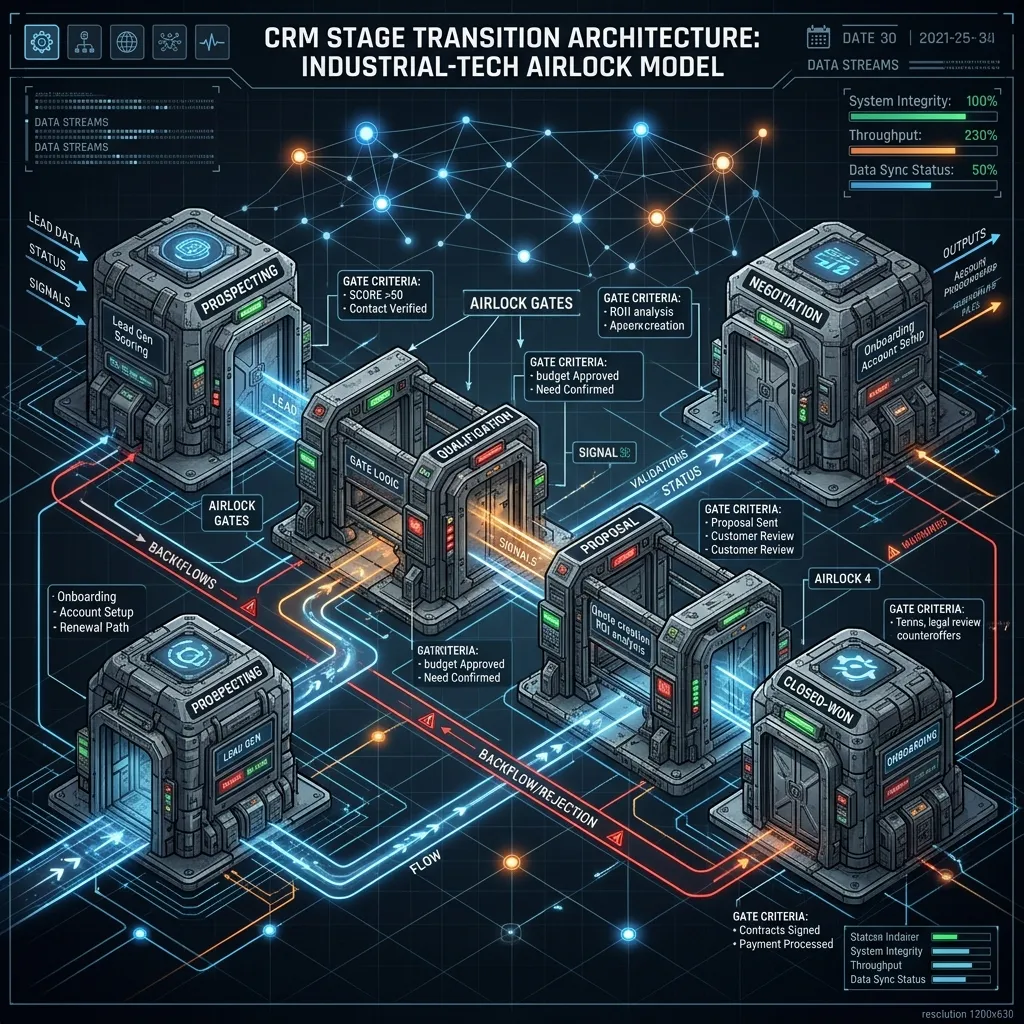
Objective stage exit criteria. A deal does not move to Evaluation because the rep is confident. It moves when an economic buyer is identified, a budget conversation is documented, and a technical review is scheduled, and those facts are in the CRM. The stage means something the manager can trust and the rep cannot game. This single change makes the weekly forecast review a materially different conversation.
A data dictionary. Every field is defined, with a named owner, a source rule or formula, and a refresh cadence. In most CRM environments at this stage, this document does not exist. When a consultant leaves without it, the next RevOps hire spends their first 60 days reverse-engineering field logic that was never written down.
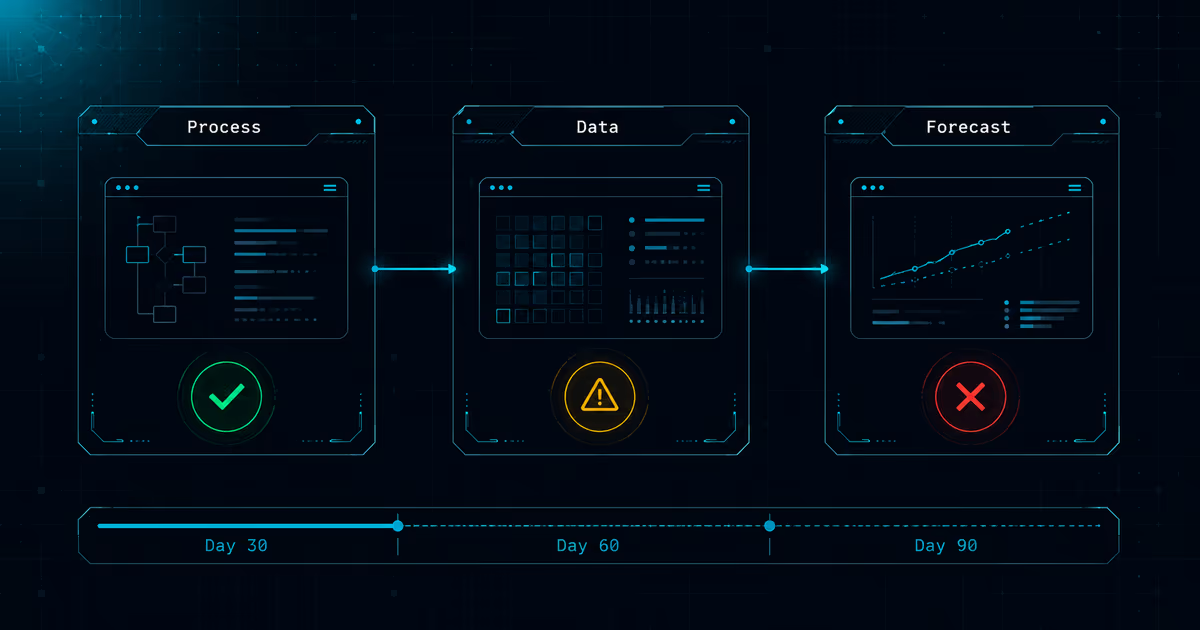
A structured 30/60/90 timeline. Days 1-30: lifecycle definitions locked across all three functions, baseline CRM audit complete. Days 31-60: routing automated, hygiene sweep run, attribution tracking live. Days 61-90: post-sale motion standardized, QBR packet built, internal team enabled. An engagement that has not produced a baseline audit by day 30 is already off track.
How we approach it at MxM Revenue Engineering
The framing above reflects how MxM Revenue Engineering runs engagements, and it is worth being direct about that.
Most RevOps consultants are hired to fix a forecast. We do not start there. The forecast is usually the last visible symptom of problems that started months earlier: stage definitions set in the first CRM deployment and never revisited, field logic built for a 5-person team that does not hold at 25, handoff rules that live in a shared folder no one reads. Starting with the forecast means fixing the display. Starting with the definitions means fixing the system.
Our pre-engagement diagnostic runs before we write a scope. We work from four standard CSV exports from your CRM: pipeline history, closed-won and closed-lost records, stage change logs, and field completion data for the last 12 months. CSV exports are the standard input because no credentials are shared and the client controls exactly what data leaves the system before anything is analyzed. For most diagnostics, this is sufficient. For companies that want ongoing monitoring after the initial engagement, API access allows continuous analysis rather than a point-in-time snapshot, and we can move to that model when the foundation is in place.
From those exports, we produce a scored health report: data decay rate, stage velocity by rep and segment, field completion on close-loss reasons, and the variance between committed forecast and actual closed revenue for the last four quarters. That report tells us whether the primary issue is a data problem, a process problem, or a sequencing problem. Usually it is some combination, but they have a sequence, and fixing them out of order produces limited impact.
To illustrate what this produces in practice: a $15M ARR SaaS company, eight quota-carrying reps, six months from a planned Series B raise. The four CSV exports surface three findings within the first week. Contact data decay is running at roughly 35%, meaning a third of the pipeline data is either outdated or missing enrichment fields the forecast model relies on. Stage velocity analysis shows deals sitting in "Proposal" for an average of 40 days with no recorded buyer action, while 60% of them appear in the weekly forecast as expected to close in the current quarter. Field completion on close-loss reasons is below 20%, so the company has 18 months of loss data it cannot analyze for pattern. None of this requires a CRM login. It requires the right exports and the right questions applied to them.
We document the logic as we build it. Every workflow has a comment explaining what it does and what breaks if it stops. Every custom field has a defined owner. The objective is a system the internal team can operate, not one they need us to maintain.
This approach is not right for every situation. If the active pipeline is under 50 deals, the data volume is too thin for the diagnostic to produce reliable signals. If the founding team is still running sales directly, the org structure will override most process changes before they take hold. We say that in the first conversation, not after the contract is signed.
Fractional, agency, or embedded: which model fits your stage
| ARR stage | Best-fit model | Typical monthly cost | Main constraint |
|---|---|---|---|
| $5M-$15M | Fractional RevOps leader | $3,000-$8,000 | Requires an internal operator to execute direction between sessions |
| $15M-$40M | RevOps agency pod | $8,000-$25,000 | Strategist you evaluated may not be the person doing hands-on configuration |
| $40M+ | Embedded / ongoing governance | $20,000-$30,000+ | Works best when some internal RevOps capacity already exists |
Cost ranges reflect the US market. UK and European engagements typically run 20-30% below these figures. Most agency pods require an onboarding fee ($3,000-$5,000) and a minimum six-month commitment. Entry-level reviews ($1,000-$2,500) work from what you describe in interviews and produce a slide deck. Structured diagnostics ($5,000-$10,000 and up) start from CRM exports: quantified findings across data decay, stage velocity, and forecast variance, plus a fix plan sequenced by revenue impact. The difference is not depth. It is whether the work starts from your description of the problem or from the data that shows what it is costing.
One practical note on the fractional model: it is the most cost-efficient option at early stage, but it is also the most dependent on internal execution. A fractional leader at one or two days a week can design the architecture. Without someone inside the company to build and maintain it, the design sits on a slide.
MxM Revenue Engineering point of view
The conversation about RevOps consulting has a consistent blind spot: buyers evaluate consultants on outputs (what they will build) more than on diagnostics (what they will find first).
A consultant who arrives with a proposed architecture before running a diagnostic has already decided what your problem is. That decision is often correct in a general sense. Pipeline hygiene, stage definition gaps, and attribution failures are present in most companies at $10M-$30M ARR. But the specific problem, the one where fixing it unlocks the most downstream impact, varies by company and by quarter. The diagnostic is not preliminary work to get through before the real engagement starts. It is the first deliverable that justifies everything that follows.
Free Diagnostic
See what a pre-engagement diagnostic looks like
Before committing to a scope, see the scored pipeline health report format we produce from your CRM exports, with no credentials shared.
See Our Diagnostic Process →