
Private equity diligence and late-stage VC reviews have changed their pattern over the past three years. The question is no longer just whether the business is growing. The question is whether the data behind the growth is auditable. A company that presents strong growth metrics but cannot produce a clean ARR waterfall or a timestamped pipeline history will spend the first half of its diligence window rebuilding data rather than explaining strategy. The controls in this article are the ones that prevent that outcome.
In a Private Equity due diligence process, the operating partner is not looking at your dashboards; they are looking at your audit trails. They want to see the sustainability and repeatability of the revenue engine. The controls below map to the three areas they check first.
What Is an Investor-Ready ARR Waterfall and How Do You Build One?
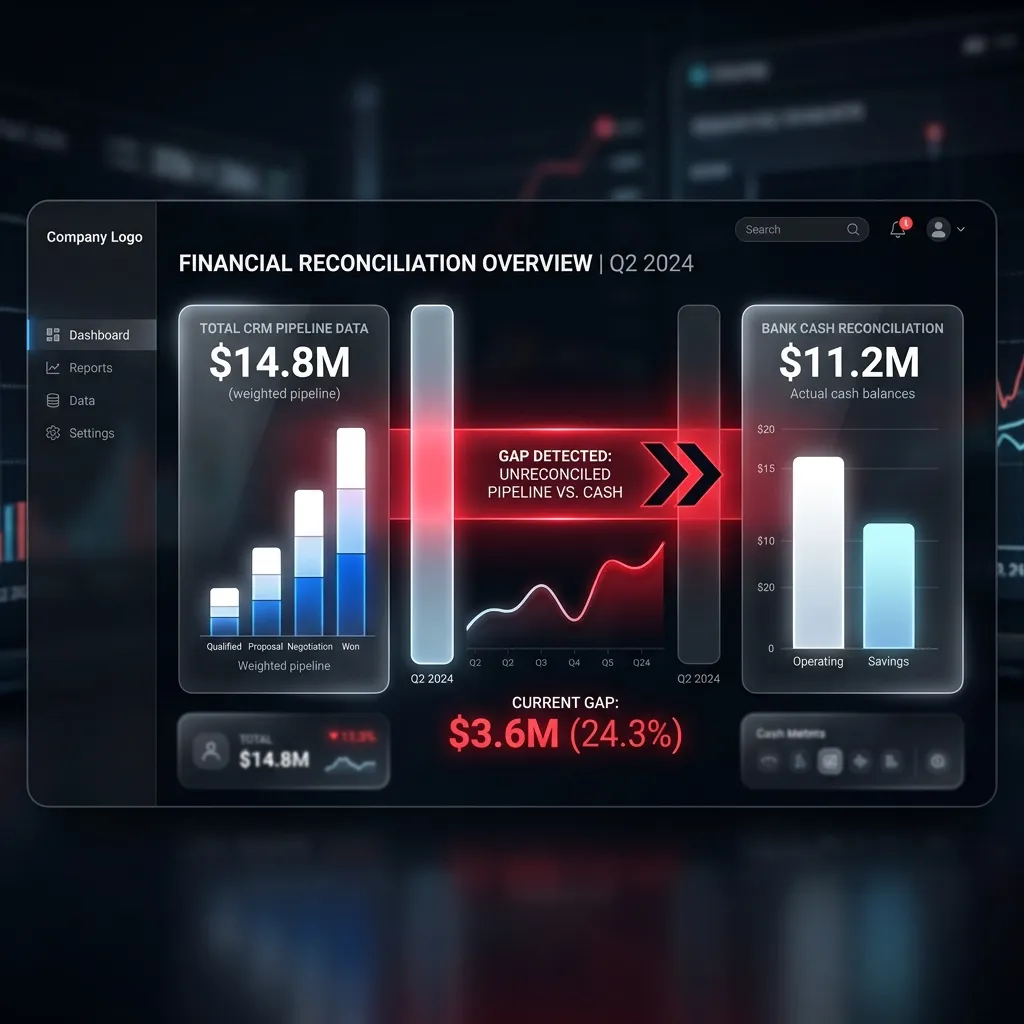
An investor-ready waterfall breaks down period-over-period ARR into its atomic components: New ARR, Expansion, Contraction, and Churn. Any adjustments line item must be backed by a forensic record. Reconciliation is the standard: ending ARR from the CRM must match beginning ARR plus all tracked changes, reconciled to the bank statement. Companies that have already run a CRM-to-bank reconciliation review will find this step materially faster to complete.
Pipeline Audit Trails
A static pipeline report is not enough. Diligence requires a record of how those deals moved. Key indicators of pipeline health include:
- Opportunity History: Timestamped logs of every stage change, amount edit, and close-date push. Companies with binary stage-exit controls already have this record embedded in the CRM workflow.
- Stage Duration Benchmarks: Comparing a deal's "Time in Stage" against historical averages to flag padding or stalling.
- Stage Skipping: Automated audit checks to find deals that jump from 'Qualification' to 'Closed-Won' without intermediate vetting.
Detecting Rep Bias
Forensic revenue engineering identifies anomalies in rep behavior that bias the forecast. Examples include "Happy Ears" (optimistic close dates) or "Pipeline Padding." By tracking rolling win rates and average cycle times at the rep level, RevOps can surface inconsistencies for review before they become quarterly misses.
Free Tool
Model your pipeline velocity in real time
Adjust all four levers and see the quarterly and annual revenue impact of each improvement scenario, with benchmark bands for Series A, B, and C.
Open the Velocity Calculator →What Do European B2B SaaS Investors Specifically Require?
Investor data standards have become more explicit over the past two years, particularly in the European B2B SaaS market. Notion Capital growth fund, a leading European B2B SaaS investor, expects portfolio ARR to reconcile to management accounts, NRR tracked quarterly for at least eight consecutive quarters, and CAC calculated on a fully-loaded basis with explicit methodology stated (Notion Capital investor commentary, 2025).
These three requirements are not arbitrary data-quality preferences. Each one maps to a specific diligence risk. ARR reconciling to management accounts means the bookings number and the finance number tell the same story. If they differ, the investor has a classification problem before they can evaluate growth. NRR tracked for eight or more consecutive quarters provides trend data rather than point-in-time data: a single quarter of strong retention is not evidence of operating control. CAC on a fully-loaded basis with explicit allocation means the efficiency calculation is not being gamed by excluding certain cost categories.
The pattern is consistent across institutional investors at this stage. The question entering a fundraising process is not whether the company can produce the data on request. It is whether the data has been governed consistently enough to be comparable across periods without reconstruction. A company that can answer yes to that question usually has the data ready within days of a request. A company that answers yes but then spends three weeks rebuilding it has the same data-quality problem the investor is looking for.
What Triggers a Data-Room Escalation During PE Diligence?
Most diligence processes start with a standard information request. Escalation happens when specific items come back inconsistently or incompletely.
The first trigger is an ARR waterfall that does not reconcile to the general ledger. If the bookings number in the CRM does not match the recognized revenue number in the accounting system, the reviewer now has a reconstruction exercise rather than an analysis. That shifts the diligence from evaluating the business to rebuilding the data, which adds time, cost, and usually a valuation discount.
The second trigger is missing stage history. If the CRM cannot produce a timestamped record of every stage change in the diligence period, the reviewers cannot verify that the pipeline health claims in the investor memo are supported by actual buyer behavior. They have to rely on management representation instead of audit trail. That is a risk the most careful investors discount explicitly.
The third trigger is close-date patterns that do not match actual close rates. If the CRM shows deals being pushed forward by 30 days every 30 days for five or six months, the reviewer knows the company is carrying phantom pipeline. That is not always a fraud signal. It is often a process signal: no one owns the decision to remove a stalled deal from the active pipeline. But it creates the same data quality problem during diligence regardless of intent.
Research context: 41% of SaaS companies had material discrepancies between investor deck metrics and accounting records (secondary source, citing SaaS Capital 2024, original methodology unverified). That figure is cited frequently in diligence contexts; treat it as directional rather than authoritative until the primary publication can be confirmed.
How Does Data Readiness Affect the Diligence Timeline?
Data readiness is the main variable in how long a diligence process takes. Two scenarios show the difference.
In the first scenario, the company enters diligence with a clean ARR waterfall that reconciles to management accounts, a timestamped CRM history covering the review period, and NRR tracked consistently for multiple consecutive quarters. The operating partner can verify claims against the data. That verification takes days. The diligence timeline stays on track and the negotiation window opens on schedule.
In the second scenario, the company needs to reconstruct stage history, reconcile CRM bookings to billing records, and normalize ARR definitions that shifted across periods. The diligence shifts from evaluating the business to rebuilding the data. That reconstruction takes weeks. Every week spent on data rebuilding is a week not spent on strategy, valuation, or terms. The longer the diligence drags, the more leverage shifts to the buyer.
Before entering a process, it is worth quantifying the valuation exposure tied to a reconstruction diligence versus a verification diligence, so investment in controls is sized against the leverage cost of arriving unprepared.
What Is a SaaS Revenue Due Diligence Checklist?
An investor-ready SaaS revenue diligence checklist covers five areas. Each maps to a diligence risk.
- ARR waterfall reconciliation. New ARR, Expansion, Contraction, and Churned ARR for each period must reconcile to the general ledger. Every adjustments line requires a forensic record with timestamps and authorization.
- Pipeline audit trail. Timestamped stage history for every opportunity in the diligence period. Stage duration compared against historical averages. Automated flags for stage skipping from Qualification to Closed-Won without intermediate vetting.
- Rep-level cohort analysis. Rolling win rates and cycle times at the rep level. Close-date patterns verified against actual close rates. Any rep showing close dates that push by 30 days every 30 days for more than two cycles gets flagged.
- NRR tracking. Net Revenue Retention tracked quarterly for at least eight consecutive periods. Trend data, not a point-in-time figure.
- CAC methodology statement. Fully-loaded cost basis with explicit allocation categories. Marketing, sales, and SDR costs included. Excluded categories documented.
What Is the Difference Between Sales Ops and Revenue Controls in a PE Review?
Basic Sales Ops is reactive; it produces reports after the quarter ends. Advanced RevOps Controls are proactive. Gaps between CRM bookings and billing records are one of the first indicators an operating partner will flag as a revenue leakage risk. The size of those gaps determines how much of the diligence timeline is spent on explanation rather than strategy. They involve:
- Role-Based Access (RBAC): Restricting who can edit contract start dates or ARR values after a deal is won.
- Immutable Logs: Ensuring that once a stage change is recorded, the audit trail cannot be manipulated.
- Automated Validation: Guardrails in the CRM that block "impossible" data (e.g., Close Date earlier than Lead Source date).
The practical implication of diligence-grade controls is that the company does not build them to prepare for a process. It builds them because operating without them creates recurring visibility gaps that affect daily management decisions, not just quarterly reviews. When the pipeline-to-cash reconciliation runs cleanly each quarter and the stage history is logged automatically by the CRM, the diligence process changes character. The operating partner can verify claims against the data rather than reconstruct them from management representation. That verification takes days instead of weeks. The faster diligence resolves, the more of the negotiation window is spent on growth strategy rather than data remediation. The PE pipeline diligence case study covers what this looks like in a company that ran the controls install before entering a process.