
This case study describes an $8.2M ARR Series A vertical SaaS company that traced a $1.4M gap between CRM bookings and cash collected, identified 17% total revenue leakage across four sources, and recovered $560K in annualized run rate through targeted controls. The scenario is a modeled composite, not an MxM client engagement. Figures are modeled outcomes.
The Situation
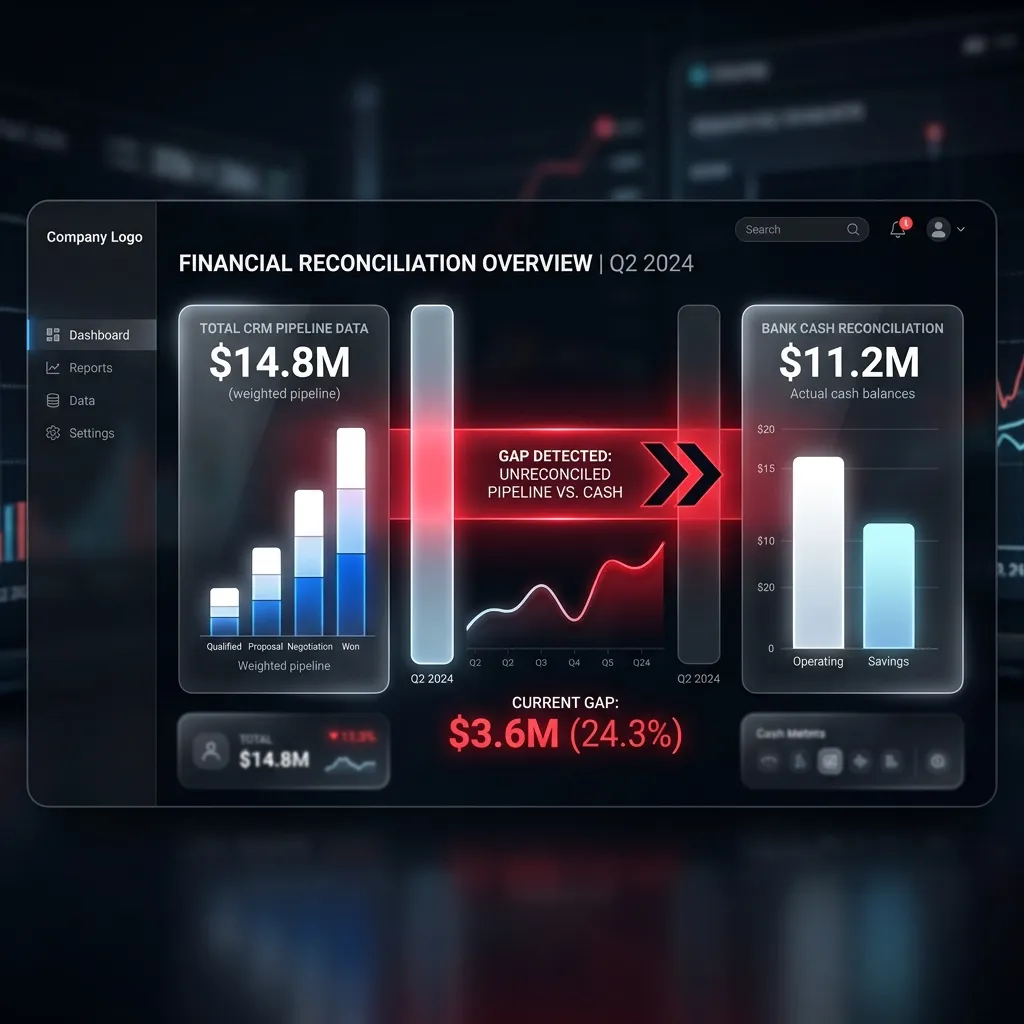
The CFO presented a problem to the board she could not fully explain: CRM showed $8.6M in bookings for the prior 12 months. Finance collected $7.2M. The $1.4M gap had four possible explanations she had identified, but none of them fully closed the math. The lead Series A investor asked for a revenue reconciliation before the next board meeting.
The company sold annual and multi-year contracts to mid-market field service businesses. Contracts were manual PDFs countersigned by the CEO. Billing was handled by the finance team working from a spreadsheet updated when the CRM was updated. The process had worked at $3M ARR. At $8M, it had accumulated four years of operating drift.
Where the Leakage Was
A CRM-to-cash reconciliation mapped every opportunity record against the corresponding invoice and payment record for the prior four quarters. Four leakage sources were identified and quantified.
Billing drift: the largest source
The average time between CRM "closed won" and the first invoice being sent was 19 days. In a subscription business, that delay pushes the billing cycle back by the same interval, compounding across every new contract. For a company adding 8 to 12 new contracts per month, a 19-day billing lag deferred roughly $390K annualized into the next fiscal year. The revenue eventually arrived, but not in the period the CRM reported.
The scale of that deferral shifts with ARR and contract volume. Model the revenue at risk from a comparable billing lag and discount ceiling in your own book to see which control carries the largest single-quarter return.
Discount bleed above policy
Four reps were consistently closing contracts at discounts of 12% to 18% above the authorized 10% ceiling. The discounts were not logged anywhere. Finance billed the discounted amount. No record existed connecting the discounted invoice to the original list price. The discount bleed was only visible after the reconciliation mapped list price from the CRM opportunity to the invoiced amount in the billing system.
Credit memo usage without policy
$210K in credits had been issued over the prior year. No policy governed when credits were appropriate. Customer success managers were issuing credits for implementation delays, billing errors, and in some cases as a retention gesture for at-risk accounts. Three customers had received credits in three consecutive quarters. The credits were legitimate in some cases and undocumented goodwill in others. None had CFO visibility.
Collection gaps beyond 90 days
$340K in invoices were more than 90 days past due. No escalation process existed. Finance sent a reminder email at 30 days. After that, collection was left to the account executive's relationship with the client. Five accounts had balances over $30K outstanding with no formal hold or escalation.
The Intervention
Each leakage source received a specific control, implemented over 10 weeks.
Billing trigger linked to CRM stage change
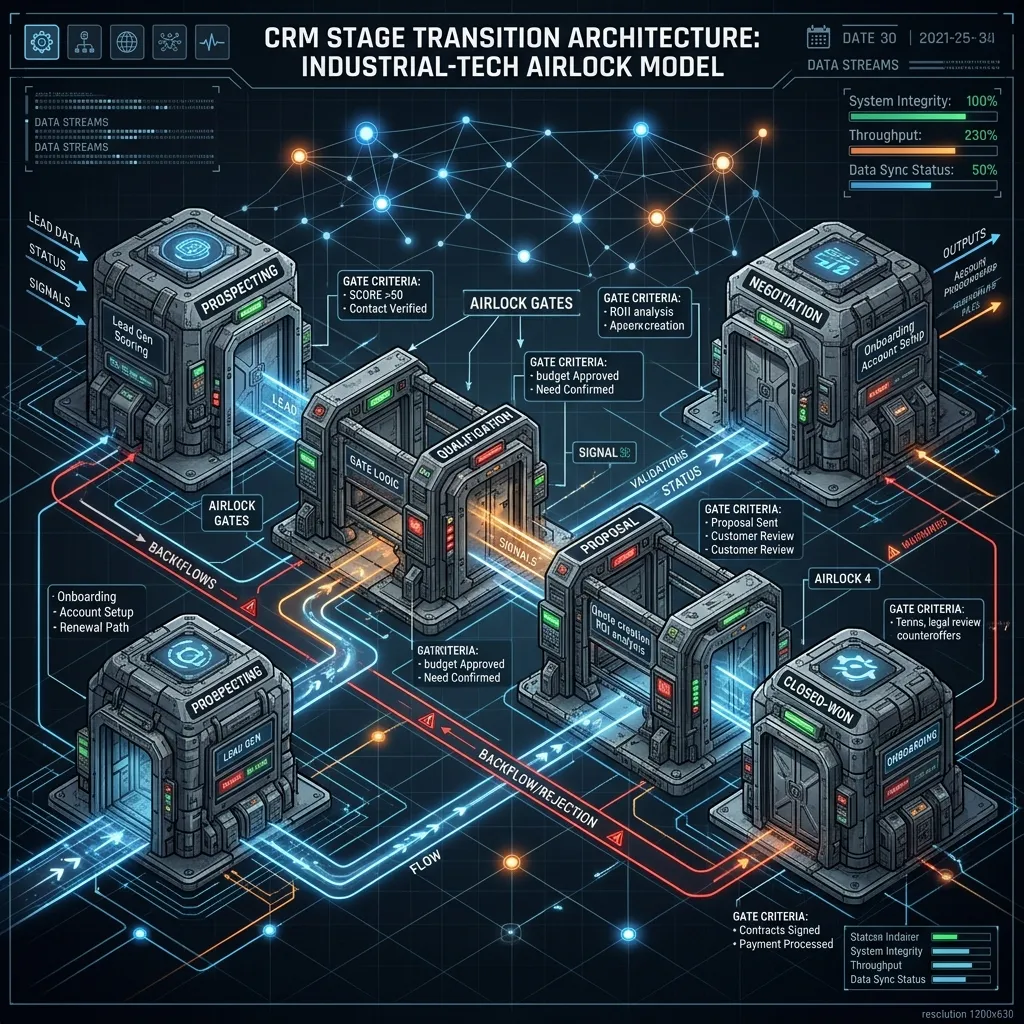
A webhook connected the CRM "closed won" stage change to the billing system. When a deal moved to closed won, the billing system automatically generated an invoice draft with the contract start date, value, and cadence pulled from CRM fields. Finance reviewed and approved the draft within 24 hours. Average days from CRM close to first invoice fell from 19 to 3.
Discount approval enforced at Stage 4
A CRM workflow block prevented any opportunity with a discount above 10% from advancing to Stage 4 without VP Sales approval logged in the system. An exception field captured the approval reason. The approval requirement made discount requests visible before a deal closed rather than invisible afterward.
Credit memo policy with CFO approval threshold
A credit memo policy defined three eligible categories: billing error by the company, contractual implementation delay beyond 30 days, and mutual agreement for material service failure. Credits outside those categories required written CFO approval with a documented business case. Credits above $5K required approval regardless of category. The policy reduced the volume of discretionary credits within the first quarter it was active.
Collections escalation sequence
A structured escalation sequence was defined: automated reminder at 30 days, VP notification at 45 days, CFO and CEO notification at 60 days, and legal hold evaluation at 90 days. The sequence was built into the billing system with automatic notifications. Five accounts with balances over $30K received VP calls within the first week the sequence ran. Three paid in full within 30 days. One negotiated a payment plan. One moved to a formal collections process.
Results
| Metric | Pre-Engagement | Post-Controls (12 months) |
|---|---|---|
| Billing Lag (avg days to first invoice) | 19 days | 3 days |
| Average Discount at Close | 14.2% | 8.1% |
| Credit Memo Run Rate | $210K / year | $67K / year |
| 90-Day Collection Rate | 72% | 91% |
| Total Revenue Leakage Rate | 17% of bookings | 3.8% of bookings |
| Annualized Recovery | Baseline | $560K |
The reconciliation was presented to the board four months after the engagement closed. The CFO accounted for every line item in the original $1.4M gap, explained what controls had been installed, and presented a 3.8% trailing leakage rate against a $9.1M ARR base. The investor noted it as the cleanest reconciliation received from a Series A portfolio company.
The Compounding Effect
Revenue leakage at Series A is structurally different from leakage at Series B or C. At $8M ARR, every source of leakage is traceable to a specific operational gap. At $25M ARR, the same gaps are more expensive and harder to close because they are embedded in a larger process and more people need to change behavior.
The four controls installed here took 10 weeks to build. The $560K recovered was not a one-time gain. It was a structural improvement to the revenue system that compounds forward: every contract signed from that point carried a billing trigger, a discount ceiling, and a collection escalation path.
Free Diagnostic
Find out where your revenue is leaking
20 questions. Scored breakdown across pipeline integrity, billing controls, discount governance, and collections. Free, approximately 10 minutes, no call required.
Run the Free Diagnostic →