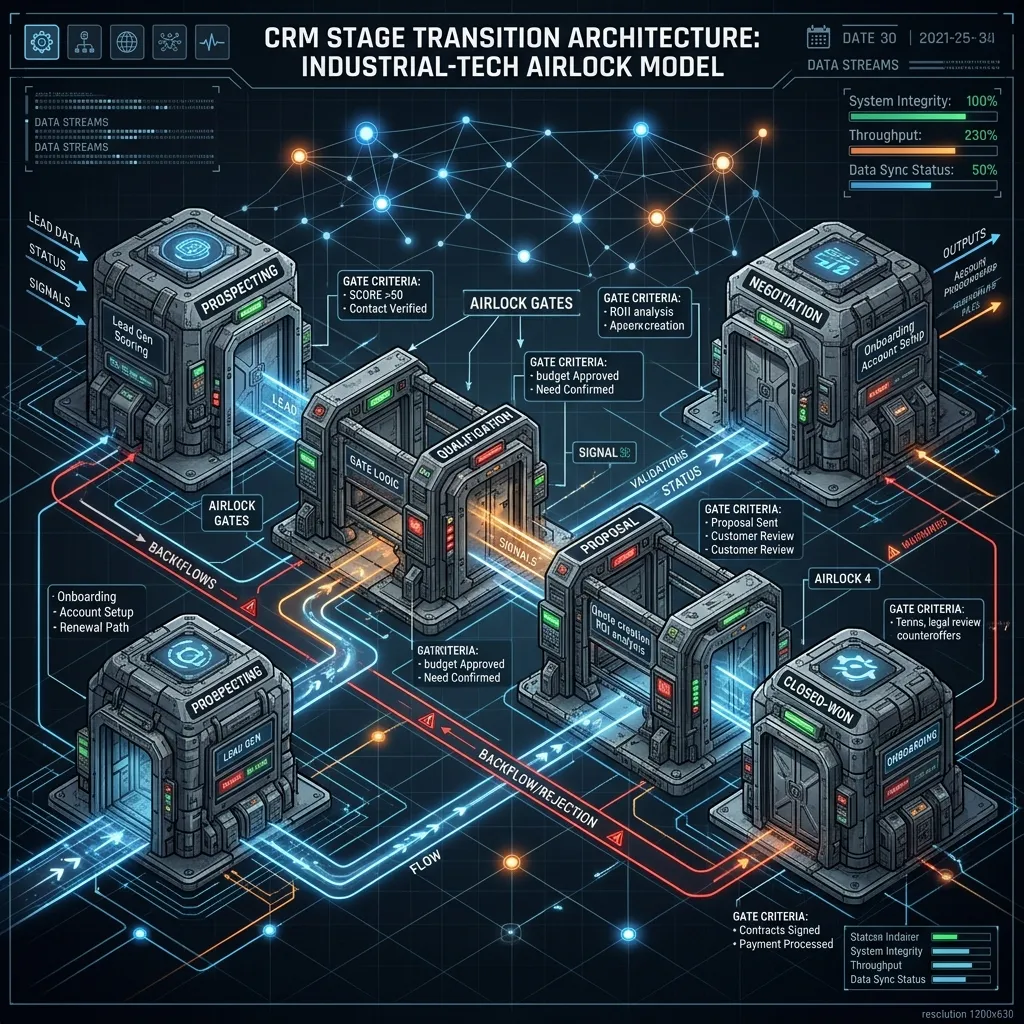

Start with the Weakest Lever, Not the Most Visible One
The most common mistake in pipeline velocity improvement is pulling the most visible lever rather than the most broken one. Opportunity count is the most visible lever because it is the easiest to measure and the easiest to move in the short term. Add more prospects, run more outbound campaigns, lower qualification standards to fill the top of funnel. The result is a larger pipeline number that produces lower velocity because win rate falls as fast as the opportunity count rises.
The pipeline velocity formula identifies the weakest lever mechanically once you have clean inputs for all four variables. Calculate your current velocity. Then calculate what happens if each variable improves by 10% independently. The lever that produces the largest absolute dollar gain per day is the highest-leverage starting point. That ranking often differs significantly from what the sales team believes the bottleneck is. Compare your result against the stage-specific benchmark bands to determine whether the gap is a single-lever problem or a systemic underperformance across all four variables.
Free Diagnostic
See which velocity lever is weakest in your pipeline
20 questions. Scored breakdown. Prioritized fix sequence. Free, ~10 minutes, no call required.
Run the Free Diagnostic →The ranking also reveals trade-off risk. If ACV is the weakest lever, the natural intervention is raising prices or moving upmarket. But moving upmarket almost always extends sales cycle. If cycle length is already above 90 days for your ACV range, adding cycle pressure by moving upmarket reduces net velocity even if the ACV gain is real. The formula tells you this before you make the investment.
Lever 1: Qualified Opportunities
Qualified opportunity count is the variable most companies manipulate incorrectly. The pattern is consistent: velocity falls, leadership responds by demanding more pipeline coverage, reps lower their qualification bar to generate the numbers, pipeline count rises, win rate falls, cycle length extends, velocity continues to fall. The intervention that was supposed to fix the problem made it worse.
The right diagnostic
Before changing opportunity count, calculate your win rate against qualified pipeline only. If win rate is above 25% on genuinely qualified deals, the problem is not qualification. It is top-of-funnel volume or deal size. If win rate is below 15% on deals that were supposed to be qualified, the qualification process is not working. Deals are entering active pipeline without meeting the criteria that predict a real buying process.
The intervention
Define stage-one exit criteria that require verifiable evidence of fit before a deal enters active pipeline. The evidence should include: a documented business problem that the product solves, a named economic buyer who has acknowledged the problem, a confirmed budget range, and a realistic decision timeline. These four elements predict deal conversion better than any lead score or behavioral signal. The architectural approach to embedding these criteria in the CRM is covered in detail in the article on stage-exit controls.
The short-term effect is a smaller pipeline count. Most RevOps leaders resist this because pipeline coverage is still reported as a proxy for health. The medium-term effect, typically visible within 60 days of enforcing the criteria, is a measurable increase in win rate and a reduction in average cycle length. The pipeline is smaller but it converts at a higher rate, and reps stop spending time on deals that were never going to close.
Lever 2: Win Rate
Win rate improvement is the outcome most sales teams and RevOps functions are tasked with producing. It is also the lever most likely to be "improved" in a way that destroys velocity rather than building it.
The discounting trap
The fastest way to raise win rate is to lower price. Discounting closes deals that would otherwise be lost. It also compresses ACV on every deal where it is applied. A 5-point win rate improvement bought with 15% average discounting produces a negative net velocity change on deals above your median ACV. The win rate number goes up. The velocity number goes down. The mechanism is identical to the qualification trap: the metric being managed improves while the underlying performance deteriorates.
Build a standing report that shows average closed-won ACV by month alongside win rate. If these two metrics diverge: win rate rising while ACV falls, discounting is the cause. The divergence is visible within two to three months of the pattern starting. Once discounting is normalized across the team, reversing it takes 12 to 18 months of deliberate repricing and positioning work.
Real win rate improvement
Win rate improvements that do not compress ACV almost always come from the same source: better qualification upstream. When the deals that enter active pipeline are better fit for the product and the buyer profile, more of them close. Win rate rises because the denominator is cleaner, not because the close motion is more persuasive. The qualification work described in Lever 1 produces the win rate improvement described here as a secondary effect. These two levers are connected.
Lever 3: Average Contract Value
ACV improvement feels like a straightforward win: raise prices, close larger deals, improve velocity. The risk is that ACV and sales cycle move together in most upmarket motions. A company that increases its median deal size from $20,000 to $50,000 by targeting larger accounts typically sees its sales cycle extend from 60 to 100 or 120 days. The velocity gain from higher ACV is partly offset by the cycle extension.
Segment the book before moving upmarket
Before pursuing an upmarket ACV strategy, segment current closed-won deals by ACV range and calculate velocity separately for each segment. A company may find that deals in the $40,000–$60,000 range close at 28% win rate in 55 days while deals in the $80,000–$120,000 range close at 14% win rate in 110 days. The higher ACV segment produces lower velocity. Moving the entire sales motion upmarket in pursuit of ACV growth would reduce total velocity even if average deal size rises.
An ACV improvement strategy that avoids cycle extension requires building a separate enterprise motion with different qualification criteria, different stage definitions, and different legal and procurement timelines, rather than repricing the existing mid-market product and hoping the sales cycle holds.
Protect the current ACV floor
ACV drift is as dangerous as ACV growth is promising. Monitor the distribution of closed-won ACV monthly, not just the average. Averages mask compression at the low end: if a team closes three enterprise deals at $150,000 and twelve smaller deals at $8,000, the average looks healthy while the median signals a problem. The smallest deals are often the most expensive to close relative to their contract value and the most likely to churn early.
Lever 4: Sales Cycle Length
Sales cycle is the denominator in the velocity formula. Reducing it increases velocity directly and proportionally. A 15% cycle reduction produces the same velocity gain as a 15% ACV increase, with no market repositioning, no pricing risk, and no impact on win rate. At Series A and Series B, cycle length is typically the highest-ROI lever available because most of the cycle duration is driven by process friction, not genuine buyer complexity.
Break the cycle by stage, not in aggregate
A 90-day average sales cycle is a single number that hides where time is actually lost. Break the cycle into stages and calculate median days-in-stage for each. Most B2B SaaS companies find that 60–70% of total cycle time is concentrated in one or two stages. The most common culprits are late-stage legal and procurement review, which often has no defined process and no owner, and early-stage discovery, which stalls because the next step was never defined at the end of the previous meeting.
Once the stall stages are identified, the intervention is process work: define the next step at the exit of each stalled stage, assign ownership, and create a time-bound handover protocol. This is not a coaching problem. It is a systems problem. Telling reps to "move deals faster" does not produce cycle reduction. Installing a defined exit protocol at the two stalled stages produces cycle reduction.
Stage exit criteria as a cycle reduction tool
Stage exit criteria serve a dual purpose. They improve qualification by requiring verifiable evidence before a deal advances. They also reduce cycle length by preventing deals from sitting in late-stage limbo for weeks while reps hope a delayed close will eventually resolve itself. A deal that fails to meet stage-four exit criteria after 21 days is identified as stalled and either re-engaged with a specific intervention or removed from the forecast. The alternative is a deal that remains in the forecast for 45 or 60 days, compressing rep capacity and distorting the velocity calculation.
The Sequencing Question: Which Lever First
The right lever depends on where the company is in its growth trajectory and which variable is most structurally broken.
| Stage | Most Common Bottleneck | First Lever to Pull |
|---|---|---|
| Series A | Low win rate from unqualified pipeline | Qualification standards (Lever 1) |
| Series B | Cycle extension from team scaling | Stage exit controls (Lever 4) |
| Series C | ACV compression from upmarket push | Deal segmentation (Lever 3) |
These are starting points, not rules. Run the lever sensitivity analysis on your actual inputs before committing to a sequencing decision. The formula tells you which lever has the most mathematical leverage on your current velocity. Start there.
To convert a lever choice into an investment case, size the revenue impact of the ranked interventions before allocating headcount or budget to any of them.
Free Tool
Model the revenue impact of each lever improvement
Enter your current inputs and see what a 10% improvement in each lever produces. The calculator runs five what-if scenarios simultaneously so you can rank the interventions before committing.
Open the Velocity Calculator →Free Diagnostic
See which velocity lever is weakest in your pipeline
20 questions. Scored breakdown. Prioritized fix sequence. Free, ~10 minutes, no call required.
Run the Free Diagnostic →The 90-Day Implementation Protocol
Velocity improvement does not produce results in 30 days. The interventions above change process and behavior, and the velocity signal typically takes 60 to 90 days to reflect the improvement because current pipeline was created before the intervention was in place. Plan for a two-quarter measurement horizon when evaluating the impact of any single lever change.
The highest-probability path to a measurable velocity gain in 90 days is to run two interventions simultaneously: install stage-one qualification criteria (Lever 1) and define stage exit criteria at the two stalled stages identified through the cycle-by-stage analysis (Lever 4). These interventions reinforce each other. Better-qualified deals move through better-defined stages faster. Win rate and cycle length improve together. The velocity gain is structural, not a function of market conditions or rep heroics. One nuance worth tracking separately: the relationship between pipeline velocity and sales cycle is not always linear. A shorter cycle that comes from faster losses rather than faster wins does not improve velocity. This distinction matters when evaluating whether the intervention is working.