
The forecast accuracy formula, period/basis/submission-point definitions, and B2B SaaS benchmarks are in the hub article. This article covers what the UK and European investor frame adds: how Notion Capital and Molten Ventures apply those standards in practice, and how FRS 102 changes in 2026 affect the reconciliation requirement.
What Forecast Accuracy Standard Do UK Series A Investors Actually Apply?
MxM interpretation, based on Optifai benchmark ranges applied to observed UK investor expectations: UK Series A investors typically treat quarterly forecast variance of 15 to 25% as acceptable, mid-teens as good, and 10% as elite once the sales motion is stable. (These are not an independent benchmark. They apply the Optifai ranges to the UK investor context observed in structured investor research.)
To put that in context: the global Optifai Sales Ops Benchmark (approximately 900 B2B organizations) shows median companies operating at 15 to 25% quarterly forecast variance, with top performers at 5 to 10% (Optifai Sales Ops Benchmark, 2025). The UK framing does not invent a separate benchmark. It applies those ranges to the specific context of what UK Series A investors ask when they review a portfolio company's forecasting record.
The important distinction is what "acceptable" means in a UK investor context. Hitting 15 to 25% variance does not automatically satisfy a UK investor. The question is whether the company measures the same thing consistently, whether the revenue basis has been stable for at least two to three quarters, and whether leadership can explain what moved each quarter without improvising in the room. A company that operated at 18% variance with the same metric basis for five consecutive quarters will typically receive more credibility than one that hit 12% variance once but changed its measurement basis between quarters.
How Do UK and US Investors Differ in How They Evaluate Forecast Variance?
The difference is not in the benchmark bands. The Optifai ranges apply equally. The difference is in where investor scrutiny concentrates.
MxM interpretation, based on observed UK and European investor communications: UK investors tend to weight definitional clarity and consistency of board reporting more than hitting a specific variance threshold. A Series A company that has held the same revenue basis and submission point for six quarters, and explains movement with cause codes, demonstrates operating control even at a 20% variance band.
US growth investors at the Series B and C stage are more likely to frame a significant forecast miss as a direct valuation-multiple concern. A miss of more than 20% in a fundraising quarter can compress the multiple applied to forward ARR, because the miss signals that the revenue number being priced carries higher uncertainty than the company's presentation implied. (MxM interpretation of observed US investor behavior patterns. Not attributed to a published study.)
For a UK Series A founder, the practical implication is that investing early in measurement consistency returns more credibility per quarter than chasing a specific accuracy target. Define the metric before the board cycle. Hold the definition stable. Explain movement with cause codes rather than weather-report language. That operating pattern is what UK investors are looking for in the period before a Series B raise.
What Does Notion Capital Specifically Require From Portfolio Companies?
Notion Capital growth fund, a leading European B2B SaaS investor, has shared investor commentary on portfolio data requirements. These are useful because they name specific expectations rather than describing them abstractly (Notion Capital investor commentary, 2025).
Three requirements are most relevant to forecast accuracy:
- ARR must reconcile to management accounts. Notion Capital expects portfolio ARR to reconcile to management accounts. This means the bookings number the sales team reports and the revenue number Finance reports must tell the same story. If they differ, the investor has a classification problem before they can evaluate growth.
- NRR must be tracked quarterly for at least eight consecutive quarters. A single quarter of strong net revenue retention is not evidence of operating control. Eight quarters of data provides trend context. An investor evaluating a Series B raise wants to see whether NRR has been stable, improving, or eroding over time, not just whether the last quarter looked favorable.
- CAC must be calculated on a fully-loaded basis with explicit methodology stated. Notion Capital expects CAC on a fully-loaded basis with explicit methodology stated. Efficiency calculations that exclude certain cost categories are not comparable across companies or funding rounds. The methodology needs to be stated so it can be held constant between periods.
These three requirements are not arbitrary preferences. Each one maps to a specific diligence risk. ARR reconciling to management accounts means the investor is not walking into a conversation where the company's internal revenue number and the finance number turn out to be different figures. NRR over eight quarters reveals a trend, not a snapshot. CAC with explicit methodology allows the investor to verify that the denominator has not shifted between meetings to produce a more favorable efficiency ratio.
What Causes UK Series A Forecasts to Miss?
The causes of forecast misses at UK Series A companies follow the same pattern as everywhere else. They are control failures, not market conditions. Research benchmark: 79% of sales organizations miss their forecast by more than 10% (SiriusDecisions research, via Forrester), and only 7% of sales organizations achieve 90% or higher forecast accuracy (Optifai Sales Ops Benchmark, approximately 900 organizations). Those figures apply globally, and UK Series A companies are not an exception.
The most common causes at this stage:
- Stage definitions that are descriptive rather than enforced. When a rep can advance a deal because they feel momentum, the CRM reflects optimism rather than buyer behavior. The pipeline looks larger than what will actually close.
- Close-date drift. Deals accumulate soft close dates that get pushed forward monthly. Finance plans against those dates. The forecast miss becomes visible only at quarter end.
- Definition drift between board cycles. The revenue basis, period definition, or submission point changes between quarters without a formal announcement. The investor compares this quarter's number to last quarter's without realizing the measurement has shifted.
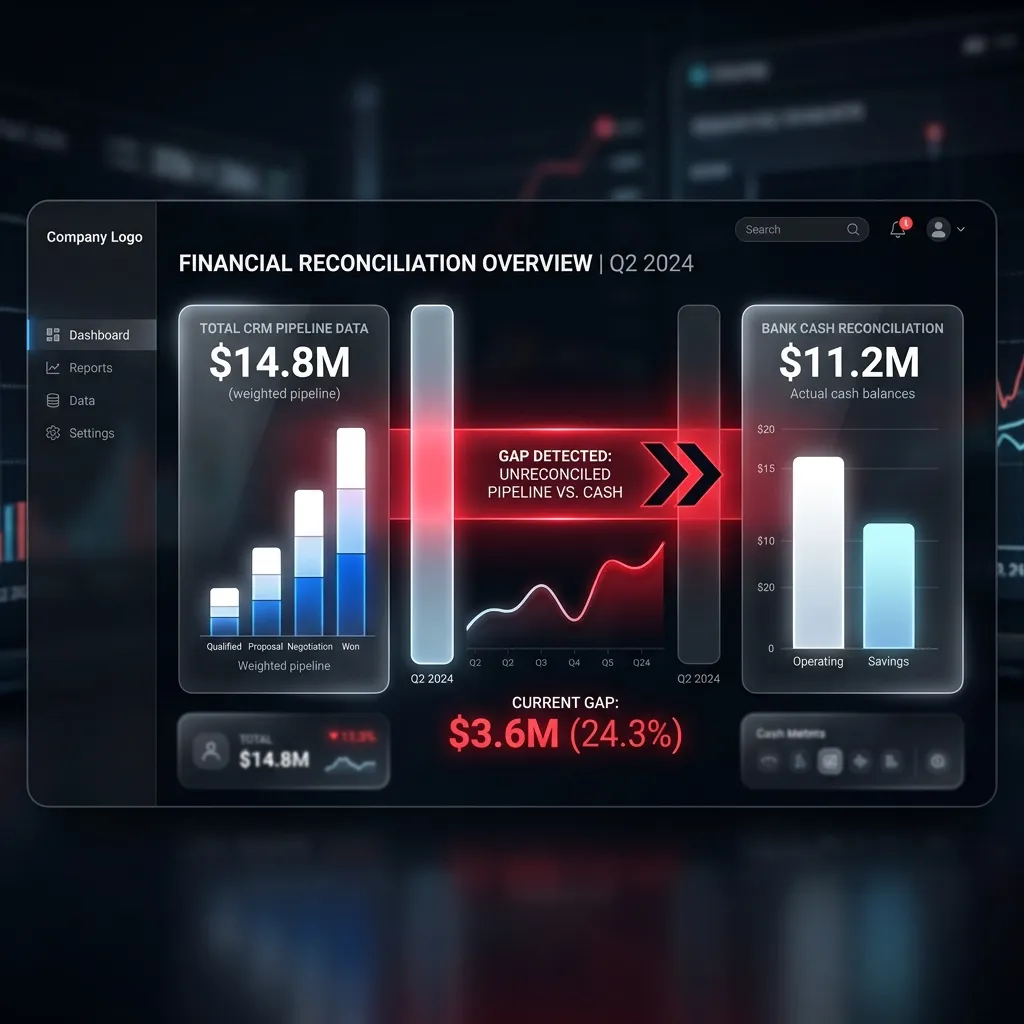
- Missing CRM-to-cash reconciliation. Bookings, billings, and collections are reviewed in separate cadences. The first time they are compared is when a board question requires an ad hoc reconstruction.
Each of these is a structural cause. Installing the right controls removes the cause rather than managing its consequences.
What Is Definitional Clarity and Why Do UK Investors Prioritize It?
Definitional clarity means the company can state precisely what it is measuring, hold that definition stable across reporting periods, and explain why it chose that definition. The three components that make a forecast definition measurable are covered in the hub article.
UK investors concentrate on this because definition changes create measurement noise that is easy to hide inside variance. A company that measured new bookings in Q1 and total ARR movement in Q2 will show different accuracy figures even if the underlying sales performance was identical. Investors who catch that pattern lose confidence in the number, not just the quarter.
In practical terms: before quoting a forecast accuracy figure in a board package, confirm that the same period, basis, and submission point have been used for at least the prior two quarters. If they have not, that correction is the first governance task. Changing the metric to improve the optics of a single quarter is the most reliable way to lose investor trust in the quarters that follow.
How Do European Series A Rounds Compare to US Medians?
The evaluative frame UK investors apply is also a function of the market they operate in. Atomico's 2025 State of European Tech reports Europe underfunded by $375B over the past decade, US venture concentration roughly twice Europe's, and a $14B to $146B gap in AI investment. Pitchwise 2026 round-size data places the global median Series A at $15M pre-money on $78.7M post-money (Pitchwise 2026). European Series A rounds trail US medians by roughly 25% to 30% at every stage, with the geographic discount narrowing from 30% to 50% down to 15% to 30% over the last two years (Dealroom and Pitchwise composite).
| Signal | Europe | US | Implication for UK Series A forecasting |
|---|---|---|---|
| Median Series A round (Pitchwise 2026) | Trails US by 25% to 30% | $15M pre / $78.7M post (global median) | Less runway per raise, tighter tolerance for unsupported variance |
| Cumulative funding gap 2014-2024 (Atomico 2025) | Underfunded by $375B | Concentration roughly 2x Europe's | Investor scrutiny concentrates on capital efficiency signals, not growth-at-any-cost |
| AI investment (Atomico 2025) | $14B | $146B | AI narratives carry less weight than defensible operating numbers in EU rounds |
| Geographic valuation discount | 15% to 30% (narrowed from 30% to 50%) | Reference band | Definitional clarity is the fastest available credibility signal for UK Series A companies |
The practical read: less capital per raise combined with tighter forecast scrutiny means measurement quality is priced. A UK Series A company that presents a stable metric basis, a variance bridge, and a reconciliation trail closes the geographic discount faster than one that presents growth headlines without an evidence layer.
What Portfolio Standards Does Molten Ventures Publish?
Molten Ventures' FY25 Annual Results disclose the operating standards Molten applies to its Core Portfolio: a 70% average gross margin target, 88% of companies funded for at least 12 months or already profitable, and 71% funded for at least 18 months (Molten Ventures FY25). Molten Ventures FY25 sustainability reporting also shows 79% of in-scope portfolio companies discuss sustainability at board meetings (Molten Ventures FY25 Sustainability Report), which sets an expectation for how comprehensively board packs are structured at Series A and B.
The forecasting implication is direct. A gross margin target that sits at 70% is only defensible if the revenue definition it is calculated against is stable across quarters. A funding cushion measured in "months to profitability" is only credible if the forecast producing that number holds definition constant. Molten's public standards create the frame most UK Series A investors read a portfolio company against, even when the fund on the cap table is different. A company that maps its own board pack to those standards ahead of a diligence conversation shortens the review.
What Do FRS 102 and IFRS 15 Changes Require From UK SaaS in 2026?
The FRC's 2024 Periodic Review amended FRS 102 Section 23 to align with the IFRS 15 five-step revenue model. The amended standard is mandatory for accounting periods beginning on or after 1 January 2026 (FRC Periodic Review 2024, corroborated across PwC UK, KPMG UK, BDO). For a UK SaaS company on FRS 102, this changes how revenue is identified, allocated across performance obligations, and recognized over time.
The forecasting implication is that the ARR number sales reports and the revenue number Finance reports must reconcile under a five-step framework starting with FY26. Sales cannot report a booking that Finance cannot recognize on the same basis. If stage-exit criteria still let a deal advance without a performance-obligation-ready contract, the reconciliation Notion Capital already expects becomes a compliance requirement, not only an operating one. UK Series A companies that install stage-exit controls and CRM-to-bank reconciliation before the FY26 transition avoid a forecast-and-audit alignment problem later.
What Operating Changes Produce the Improvement Pattern UK Investors Want to See?
The improvement mechanism is the same regardless of investor geography. What changes is the emphasis and the sequence.
The first layer is stage-exit controls. When stage criteria become binary, the CRM reflects buyer behavior instead of rep optimism. The pipeline compresses to reflect only opportunities with genuine evidence of buyer commitment. That compression makes the forecast more accurate not by changing the sales process but by changing what the data model is allowed to say. The pipeline review changes shape: managers spend less time chasing status updates and more time examining the deals that still require genuine judgment.
The second layer is CRM-to-bank reconciliation. Once stage data is governed, the company can trace the bookings number from the CRM record through the billing entry to the bank deposit. That chain is what both UK and US investors ask for when they want to understand revenue quality. It is also what satisfies Notion Capital's requirement that ARR reconcile to management accounts: the reconciliation is the mechanism, not the end product.
The third layer is the review cadence that holds both systems honest across quarters. A weekly pipeline check that enforces stage evidence, a monthly reconciliation between bookings and billing, and a board pack that carries the same variance definition from one period to the next. That cadence produces the measurement consistency UK investors treat as the primary signal of operating control, more than any specific accuracy number.
A realistic improvement path: define the metric in quarter one, install stage controls in quarter two, run the first CRM-to-cash reconciliation in the same quarter, and compare variance bands at the end of quarter three. A Series A company that follows that sequence and starts with honest baseline measurement typically narrows unsupported variance within two to three quarters without changing the sales team. A Helium42 case study describes a UK SaaS company at £65M ARR that reduced its forecast cycle from 12 days to 2 days and moved MAPE from 12% to 6% after installing a governed forecasting layer on Pigment (Helium42 case study, Pigment deployment). The improvement mechanism was the control architecture and the reconciled data layer, not the tool alone. The Series A and B forecast accuracy guide covers the four breakpoints behind most misses and the baseline measurement approach in detail.
Free Model
What is your forecast variance actually costing you?
Run the numbers: model your quarterly revenue at risk, the cost of inaction, and how fast the fix pays back, with stage-specific benchmarks for Series A–C.
Run the ROI Model →